One bad section, and the question of whether it is worth replacing on its own
Replacing a single panel is sometimes the sensible, economical answer and sometimes money poured into a door that was already finished. Which of the two depends on three things: the age of the door, whether the section is still manufactured, and what the rest of it looks like.
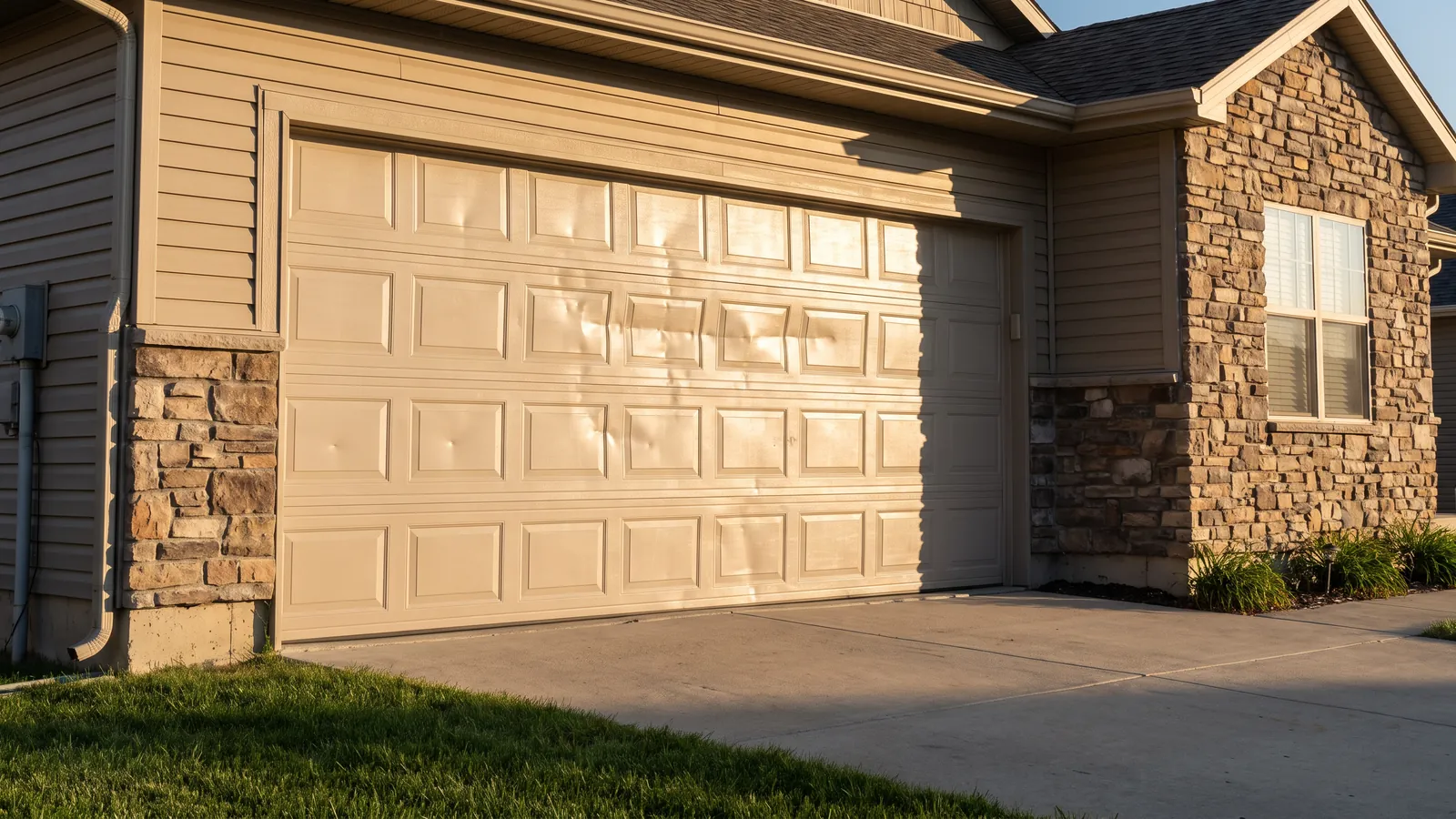
How panels get damaged here. Hail is the big one — the Kansas Insurance Department recorded $128.3 million in storm claims on the Kansas side in 2025, with $91.0 million of it in Johnson County alone, and garage doors take a disproportionate share because they are a large, thin, vertical steel surface facing the weather. Hail dents the upper sections first and leaves a characteristic field of shallow pocks rather than one crease. The second cause is impact: a bumper, a trailer hitch, a basketball post, which creases the bottom section in a line. The third is corrosion eating the bottom section from the inside out, courtesy of salt and meltwater, which is quieter and often further along than it looks.
The availability question comes first. Manufacturers change panel profiles, embossing patterns and colour formulations regularly, and they do not keep old stock for long. On a door up to roughly ten or twelve years old there is a fair chance the section can still be had. Beyond that, the honest answer is often that it cannot, or that what is available is a close-but-visibly-different match — a slightly different woodgrain emboss, a white that reads warmer than the panels beside it. We find out before quoting rather than after, and we tell you plainly if the match will be imperfect.
Then the arithmetic. A single section with labour frequently lands at a third to a half of a complete new door. If the rest of the door is sound, the springs are healthy and the hardware has life in it, that is a good deal. If the door is twenty years old, the bottom section is rusting, the rollers rattle and the springs are near their cycle count, you are spending half the price of a new door to end up with an old door that has one new panel on it. We will say so.
If it is hail and you are claiming, do not let anyone touch it first. Photograph the door in good light from straight on and at an angle — pocking shows up far better in raking light — and get a written, itemised estimate before authorising work. Insurers commonly want to see both the damaged sections and the whole door, because a door that cannot be matched may be replaced entirely under the claim. We will supply the itemised quote. What we will not do is tell you the damage is worse than it is, or offer to make a deductible disappear, which is a thing some storm-chasing outfits suggest after a hail event and is fraud.
What's included
Availability checked before quoting
We confirm the section, profile and colour can actually be sourced for your door before you commit to anything.
Honest match expectations
If the replacement will read slightly different against weathered panels, you hear it in advance, not afterwards.
Full-door comparison every time
The cost of the panel and the cost of a new door, side by side, with the state of the springs and hardware factored in.
Hardware replaced with the section
Hinges, rollers and bottom brackets on the affected section renewed while the door is apart.
Itemised estimates for claims
Written in the form adjusters expect, with the damage documented, for hail and impact claims.
Door rebalanced afterwards
A new section changes the weight slightly; the spring tension gets checked and adjusted to suit.
Panel replacement prices on the Kansas side
| Job | Typical price | Notes |
|---|---|---|
| Single section, standard steel | $320 – $620 | Supplied, fitted and colour-matched where possible |
| Bottom section with new brackets | $390 – $720 | Includes the hardware that corrodes with it |
| Insulated section | $430 – $820 | Heavier panel, higher material cost |
| Two sections, same door | $560 – $1,100 | Common after significant hail |
| Carriage or decorative panel | $520 – $980 | Where the style is still produced |
| Hinges and rollers with the panel | $90 – $220 | While the door is apart |
| Match assessment and estimate | $69 – $119 | Waived when the work goes ahead |
| Full door instead | $1,850 – $3,100 | See replacement |
These are 2026 ranges for the Kansas side of the metro, to give you a figure to plan around. What you pay is agreed in the driveway before work starts, with parts and labour listed separately; new doors and openers get a written figure that holds for 30 days.
Recent work
Questions we get about panel replacement
Can you match my existing panels?
Sometimes. It depends on the manufacturer, the age of the door and how much the original colour has weathered. Up to about ten or twelve years old you have a reasonable chance. Older than that and panels are often discontinued, and even a correct part number can read slightly different against twenty years of sun. We check availability before quoting and tell you honestly how close the match will be.
Is a panel cheaper than a new door?
Usually, but not always by enough to be the right call. One section with labour often comes to a third or a half of a complete new door. That is good value on a door that is otherwise sound, and poor value on a door that is twenty years old with rust at the bottom and springs near the end of their cycles. You will get both figures.
Will insurance pay for hail damage to a garage door?
Often, under the property section of a homeowners policy, subject to your deductible. Document it before any work: straight-on photographs and raking-light shots that show the pocking, plus a written itemised estimate. If the panels cannot be matched, some insurers will fund a full door rather than a mismatched repair, so it is worth establishing availability early.
Someone knocked on my door after the hailstorm offering to cover my deductible. Should I?
No. Absorbing or rebating a deductible to win storm work is insurance fraud, and the homeowner who agrees to it is part of it. Storm-chasing crews appear across Johnson and Wyandotte counties after every significant hail event. Use somebody you can still find in six months, and let the claim run honestly.
Just the bottom panel is rusted. Is that worth doing?
Depends what is behind it. Bottom-section rust in this climate comes from salt and meltwater sitting against the panel, and by the time it shows outside, the inside face and often the bottom brackets have gone too. Replacing the section and the brackets is reasonable on a newer door. On an older one it is usually the first of several, and that changes the maths.
How long does a panel replacement take?
The fitting is typically two to three hours once the part is on site. The wait is in the supply — a stocked colour in a current profile might be a few days, while a less common section can take a couple of weeks. You get the lead time with the quote, not after you have committed.