The bar above the opening, and why the numbers stamped on it matter
A torsion spring sits on a shaft above the door, wound tight, and converts its stored energy into lift. Everything about how your door feels — whether it glides, whether the opener strains, whether it slams — comes down to whether that spring is the right one.
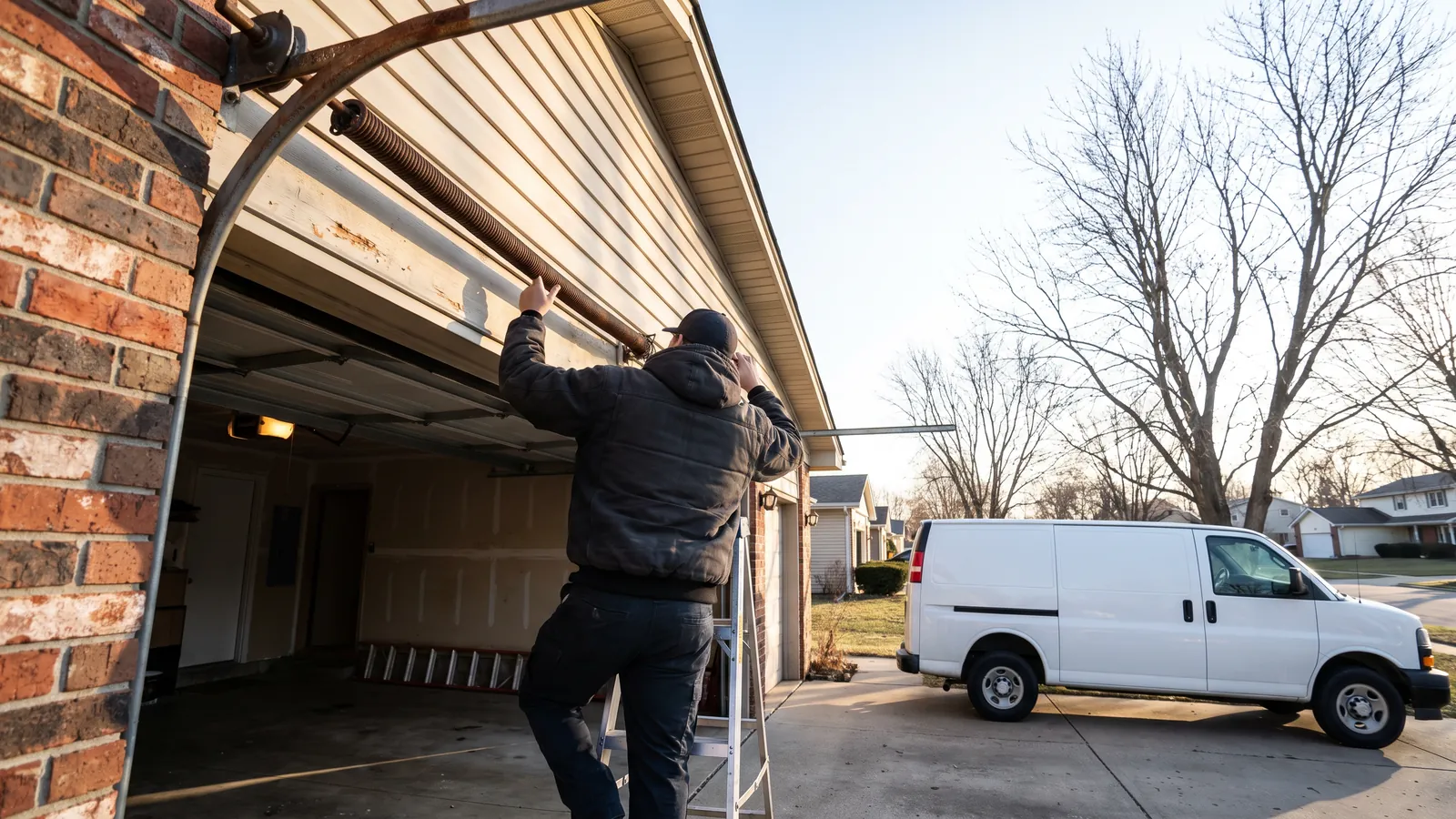
Torsion is the modern arrangement and the one on most doors fitted since the 1980s: one or two springs on a steel shaft above the opening, with cable drums at each end. Wind the spring, and it counterbalances the weight hanging from those cables. Get the match right and a 200-pound door can be raised with one hand. Get it wrong and everything downstream suffers — the opener works harder than it was designed to, the cables take uneven load, and the door either floats up or drops like a guillotine.
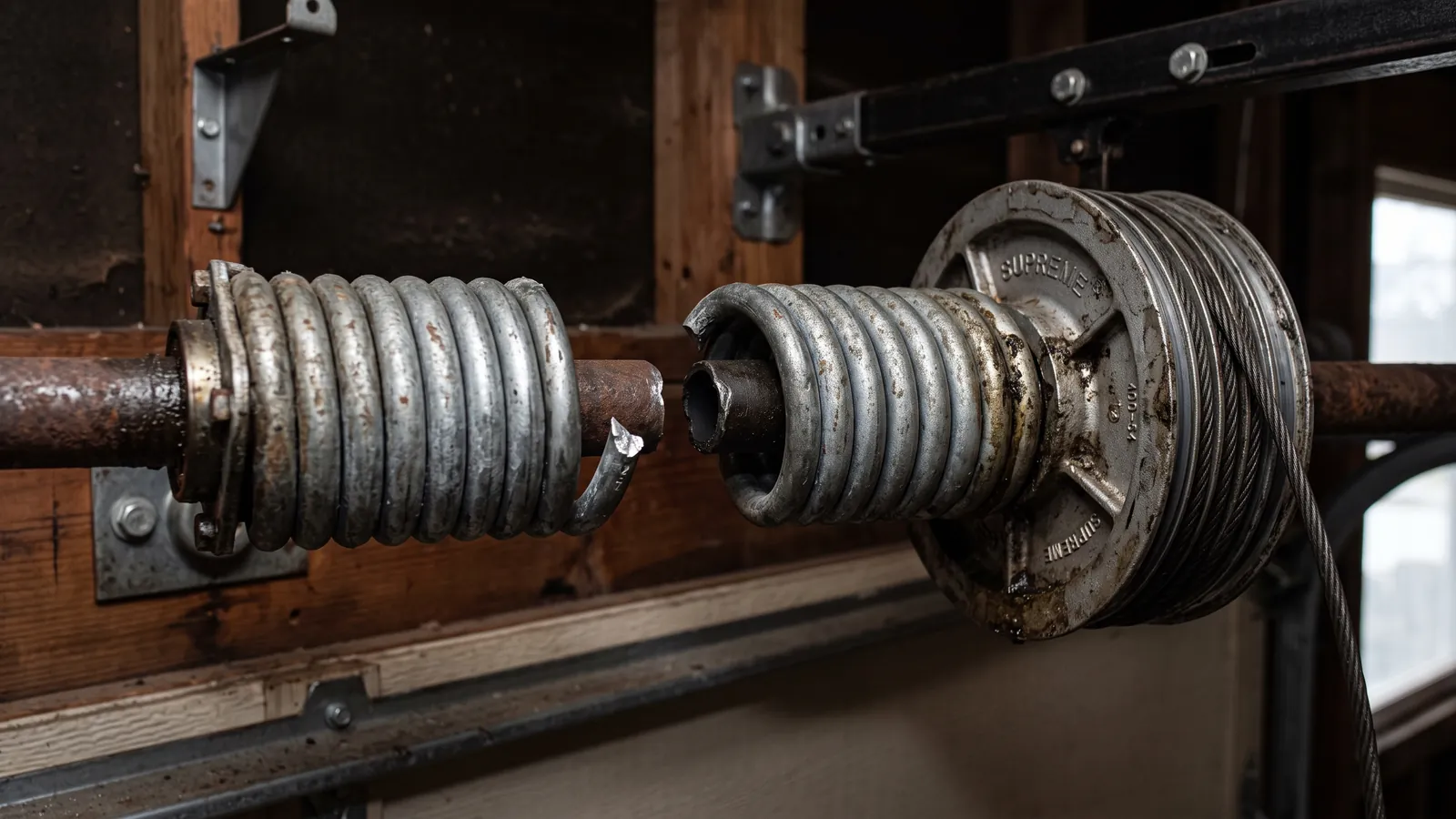
Three numbers define a torsion spring. Wire gauge is the thickness of the steel. Inside diameter is the bore that fits over the shaft, usually 1¾ or 2 inches on residential doors. Length is how much wound steel there is. Together with the wind direction — left-hand and right-hand springs are not interchangeable — these determine exactly how much lift the spring provides. A technician reads them off the existing spring where the cones allow, but the honest method is to weigh the door, because the spring that is on there now may have been a near-enough substitute fitted by somebody in a hurry years ago. Doors that eat openers almost always turn out to be slightly under-sprung.
Why this is the one job to hand over. A wound torsion spring holds a serious amount of energy in a small space. It is released and reapplied with winding bars inserted into the cone, a quarter-turn at a time, and the failure mode is a bar leaving the cone under load. There is no clever technique that removes that risk; there is practice, the correct bars, and the discipline to never put a hand or a face where a bar would travel. Springs are inexpensive to buy online, which is precisely why the internet is full of people explaining how they nearly lost a thumb. Rollers, seals and sensors are reasonable things to tackle at home. This is not.
A proper replacement ends with checks, not just a new spring: the shaft and bearings inspected for wear, the drums seated and the cables wound evenly so the door rises level, the spring wound to the correct number of turns for the door's height, the balance tested by hand at several points in the travel, and the opener's force and travel limits reset to suit the door's new behaviour.
What's included
Weighed, not assumed
The door's actual weight drives the spring specification, so you do not inherit somebody else's near-enough guess.
Gauge, bore, length and wind
All four matched correctly, including left and right-hand springs on a two-spring shaft, which are not interchangeable.
Bearings and shaft inspected
End bearings and the centre bracket wear quietly and are cheap to replace while the shaft is already apart.
Drums reset, cables wound level
Uneven drum seating is why doors rise crooked and why one cable frays long before the other.
Wound to the right turn count
Turns are set for the door height, then adjusted on test until the door holds position by hand.
Opener recalibrated after
Force and travel limits reset to the restored balance, which is what stops a new spring quietly wearing out the motor.
Torsion spring replacement prices on the Kansas side
| Job | Typical price | Notes |
|---|---|---|
| Single torsion spring | $215 – $340 | Supplied, fitted, wound and balanced |
| Matched pair | $310 – $495 | Standard 10,000-cycle rating |
| High-cycle pair (25,000) | $395 – $640 | The better arithmetic on a busy household door |
| Spring plus end bearings | $280 – $450 | Worth doing together; bearings are the cheap part |
| Spring, shaft and drums | $460 – $820 | For a shaft that is worn or has been running out of true |
| Torsion conversion from extension | $480 – $880 | Where headroom allows it |
| Heavy or oversized door | $420 – $780 | Solid wood and carriage doors need heavier stock |
| Balance and turn adjustment only | $95 – $170 | When the spring is sound but the wind is wrong |
These are 2026 ranges for the Kansas side of the metro, to give you a figure to plan around. What you pay is agreed in the driveway before work starts, with parts and labour listed separately; new doors and openers get a written figure that holds for 30 days.
Recent work
Questions we get about torsion spring replacement
How many turns does a torsion spring need?
It follows the door's height — a seven-foot door typically takes around seven and a half to eight turns, an eight-foot door more. But the number is a starting point, not the answer. The real test is the door's behaviour: lift it by hand to waist height and let go. It should stay. Drift up and there is too much tension; sink and there is too little. The final quarter-turns are set by that test.
One spring or two?
Two is better on anything but a light single door. The load is shared, the door stays level if one weakens, and the cables take even tension. Many builders fitted a single spring to keep costs down on new estates, and converting to a two-spring shaft is a sensible upgrade when the time comes to replace anyway.
What does the colour on the end of the spring mean?
It is a wind-direction code — manufacturers paint the cones so an installer can tell a left-hand from a right-hand spring at a glance. It is not a quality or strength marking, and the colours are not standardised across every maker, so it is a useful hint rather than a specification.
Can a torsion spring be adjusted instead of replaced?
Sometimes. If the spring is sound but the door has gone slightly heavy or light — which happens after a new, heavier door skin, or when an installer guessed the turns — a quarter or half turn restores the balance and costs a fraction of a replacement. If the spring is at the end of its cycle life, adjustment just delays the inevitable by weeks.
Why is my door rising crooked?
Usually a drum that has slipped on the shaft, so one cable is winding more than the other. It can also be a cable that has jumped a groove, or a door that was reset after coming off the rail without the drums being re-seated properly. Left alone it frays a cable and eventually pulls the door off the rail again, so it is worth fixing promptly.
Is a torsion spring safer than extension springs?
Yes, generally. A torsion spring is captive on the shaft, so when it fails it stays put — which is why the failure is a loud bang rather than anything flying. An extension spring without a containment cable can throw its broken half across the garage. If you have extension springs, the cables are the thing to check today.